Baptism Photographer in Greece: A Guide to the Greek Orthodox Christening
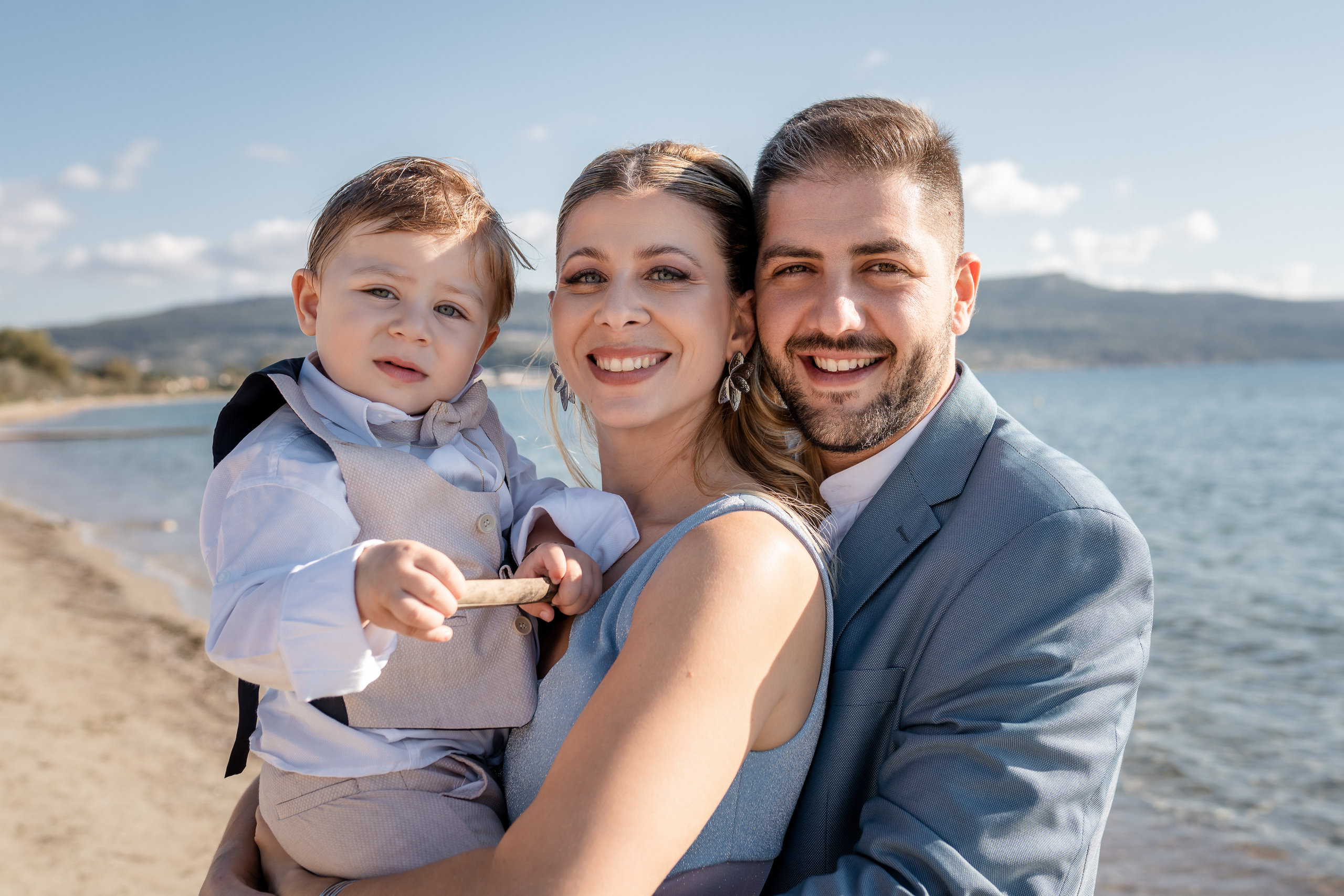
A baptism photographer in Greece gets to live every moment of the sacrament up close, and knows how quickly it goes by. Whether you live in Greece or you are flying in from abroad to baptise your little one in your family’s home village, a Greek Orthodox christening is one of the most moving days a family can share. If you want to understand exactly what happens during the service, this guide is for you.
As a wedding and baptism photographer based in Kalamata, I photograph christenings all over Messinia, Arcadia, Laconia and Athens. Below I explain the Greek Orthodox baptism step by step, the role of the godparent, the documents you need, the traditions behind the oil sheets, the candle and the witness pins, and the moments every family wants in their photographs.
Quick answer: A Greek Orthodox christening includes the prayers of exorcism and the renunciation of Satan at the entrance, the Creed, the blessing of the water and oil, the anointing with oil, triple immersion in the font, chrismation with Holy Myrrh, the white garments, a symbolic tonsure and a procession around the font. You need the child’s birth certificate, the parents’ IDs and an Orthodox godparent. A good baptism photographer in Greece captures it all discreetly, with natural light, from the preparations to the party.
Table of Contents
Why hire a baptism photographer in Greece
A baptism is not a posed photo shoot. The most precious moments last seconds: the first splash in the font, the godparent’s face as they receive the baby in the white sheet, a grandmother wiping away a tear. Without a photographer who knows the service, these moments are easily missed: the priest moves quickly, the church is full and everyone is busy.
Because I know the order of the sacrament, I am always in the right place just before each moment, without getting in the way of the priest or your guests. For families who live abroad, it also means one less thing to organise from a distance: a photographer who knows the churches, the light and the local customs, and who will tell the story of the day as it really was.
Good christening photography is not just for today. In twenty years, your child will open the album and see their grandparents, their godparent as a young person, the family home and the church exactly as they were that day. That is why I give the same attention to the big moments of the sacrament and to the small, quiet details nobody notices while they happen: a hand squeezing another, a glance, a smile.
The Greek Orthodox christening, step by step
The baptism service follows an order that has remained essentially unchanged for centuries. Here is what happens, in simple words (based on the description of the service by the Greek Orthodox Archdiocese of Australia):
1. Exorcisms and the renunciation of Satan
The service begins near the entrance of the church. The priest breathes three times in the sign of the cross over the child and reads the prayers of exorcism. Then the godparent, holding the baby, turns to the west and renounces Satan three times on the child’s behalf.
2. The Creed
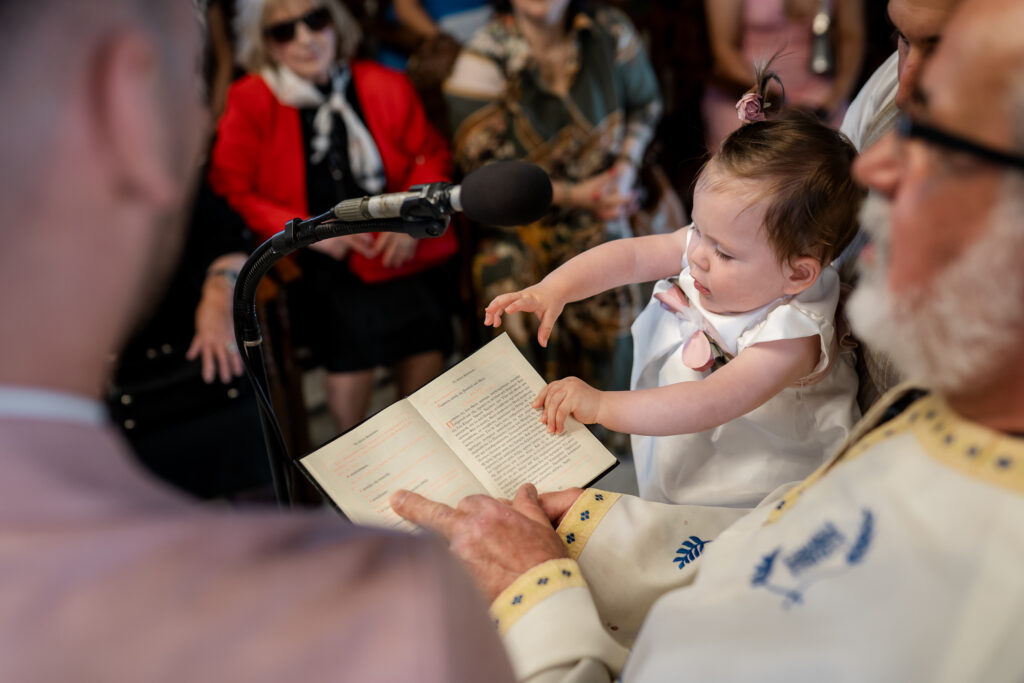
The godparent then turns to the east, declares three times their union with Christ and recites the Creed (the Symbol of Faith). For many godparents this is the most emotional moment of the day, and one I always photograph up close.
3. Blessing of the water and the oil
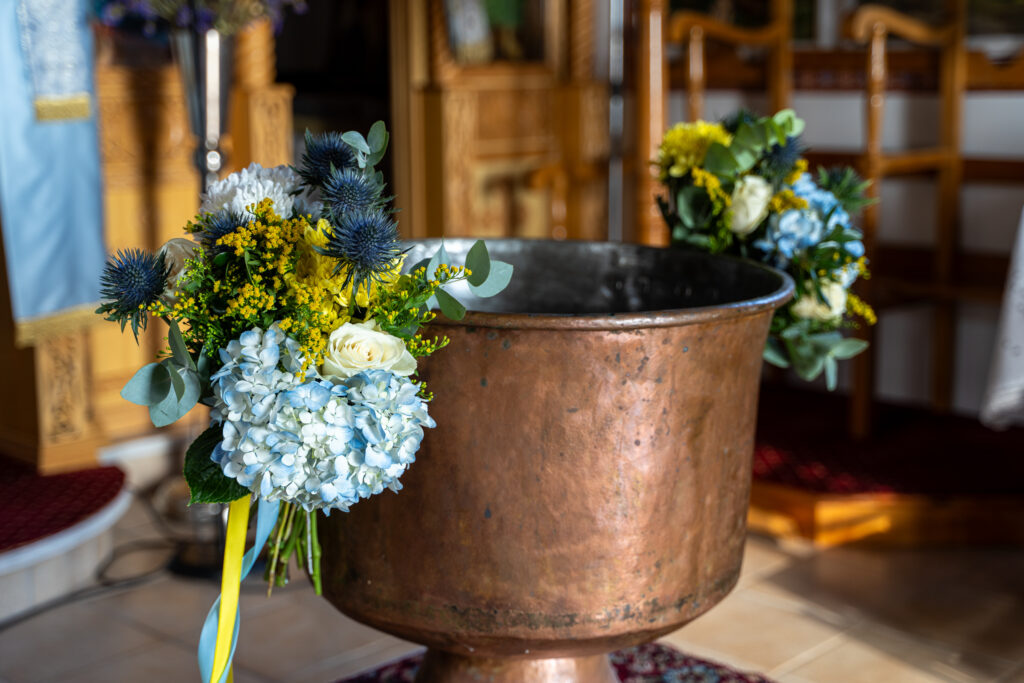
The priest blesses the water in the font and then the olive oil, which he pours into the water in the sign of the cross three times.
4. Anointing with oil
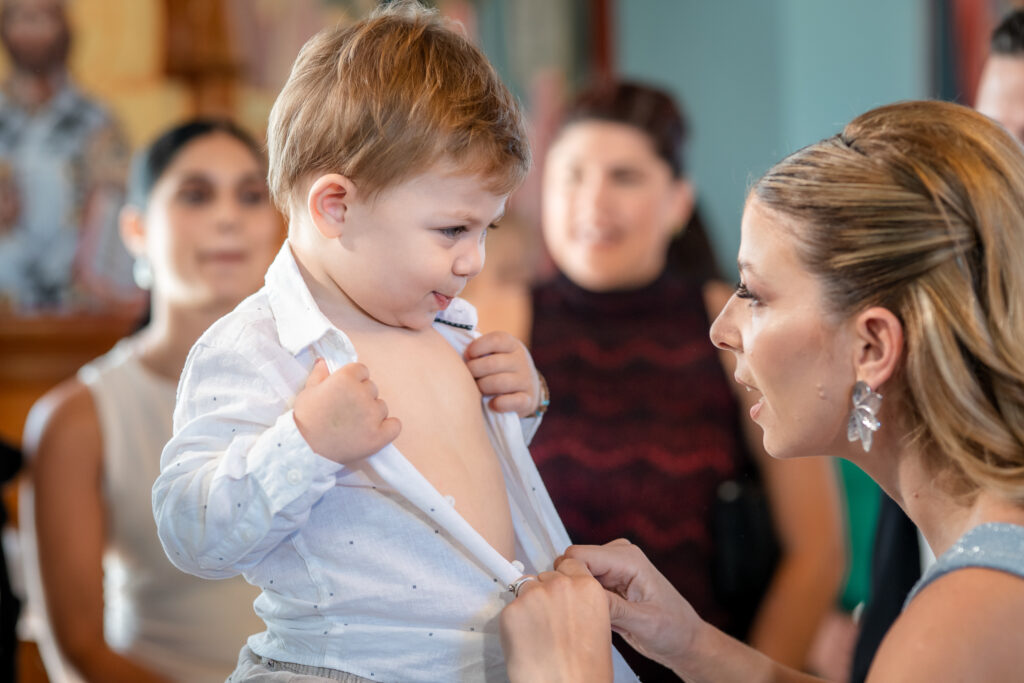
The baby is undressed and the priest anoints the child with the blessed oil on the forehead, chest, ears, hands and feet. In many churches the godparent then continues, gently rubbing oil over the baby’s whole body. Little ones often protest at this point, and that is perfectly normal: these are some of the most honest photos of the day.
5. The triple immersion
The heart of the sacrament. The priest immerses the child in the font three times, saying the child’s name, “in the name of the Father, and of the Son, and of the Holy Spirit”. It lasts only a few seconds, so this is where experience matters: I take my position in advance, with an angle that shows both the baby and the priest’s hands.
6. Chrismation and the white garments
Immediately afterwards, the priest anoints the child with Holy Myrrh (chrismation). The godparent receives the baby in a white sheet, and the child is dressed in new white clothes, a symbol of the new life in Christ, and receives the baptismal cross.
7. Tonsure, procession around the font and readings
The priest cuts three small locks of hair in the sign of the cross, a first offering to God. Then the godparent, holding the child and the lit baptismal candle (lambada), walks around the font three times with the priest while the cantor chants. The Epistle and Gospel readings and the final prayers follow. At the end, the mother receives the child from the godparent and kisses their hand, and the guests come forward with their wishes: “Na sas zisei!” (may the child live long for you).
The godparent (nonos or nona): role and requirements
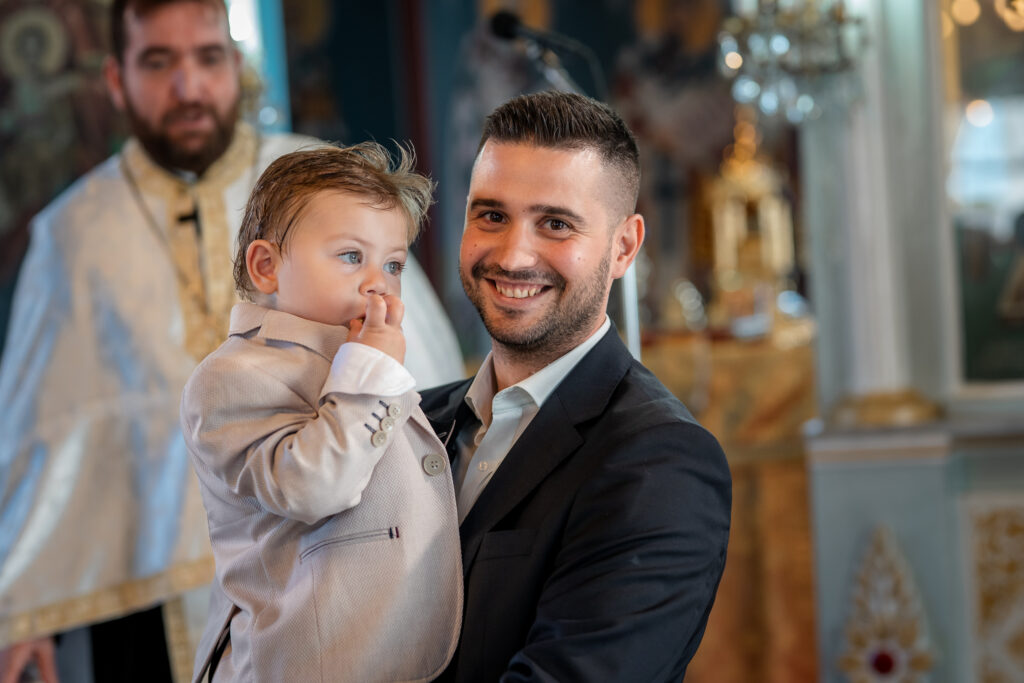
In Greece the godparent (nonós or noná) is a lifelong role: a spiritual parent who promises to help raise the child in the Orthodox faith. Traditionally the godparent also gives or confirms the child’s name and takes care of the items needed for the ceremony.
According to the Holy Metropolis of Mani, the godparent must be a baptised adult Orthodox Christian, cannot be one of the child’s parents, a member of the clergy or a monk, and, if married, must not be married only in a civil ceremony. Requirements can differ slightly between dioceses, so always confirm them with your parish priest.
Documents for a baptism in Greece
The paperwork is simpler than most parents fear, but it should be ready well before the day. Indicatively (as listed by the Holy Metropolis of Mani):
- The child’s birth certificate (lixiarchiki praxi gennisis), issued for the purpose of the baptism.
- Valid IDs of both parents, with details that match the birth certificate.
- The godparent’s documents proving they are Orthodox (e.g. a baptism certificate) and showing their marital status.
- Special statements where needed, for example if one parent cannot be present.
After the service, the priest issues a baptism certificate, which is then registered with the Greek civil registry. According to the official Greek registry of public services (MITOS), the declaration is made within three months of the baptism and can also be submitted online via gov.gr. If you live abroad, contact the parish and your Greek consulate early to check which documents need translation or certification.
For everything you need to bring on the day, see my Greek Orthodox baptism checklist.
After the baptism: the three Holy Communions
By tradition, on the Sundays following the baptism the godparent brings the child to church to receive Holy Communion three times, lighting the baptismal candle each time. It is a lovely, quiet continuation of the big day, and a nice chance for a few simple family photos on your phone.
Greek baptism traditions: lambada, ladopana and martyrika
- Lambada: the decorated baptismal candle the godparent carries around the font.
- Ladopana: the set of white towels and sheets, the bottle of olive oil and the soap used for the anointing.
- Baptismal outfit: the new white clothes the baby wears after the font, usually a gift from the godparent.
- Martyrika: small pins or keepsakes given to the guests, the “witnesses” of the baptism.
- Bomboniere: sugared almonds wrapped in tulle, offered at the church or at the reception.
Each of these details tells part of your family’s story, so I always photograph them before the service starts, together with the decoration of the church and the font.
What a baptism photographer in Greece captures: the moments not to miss
Every christening is different, but there are moments every family wants to find in their album. This is the list I always keep in mind:
- The preparations: the baby with the parents at home or at the church, before the guests arrive.
- The details: the Greek Orthodox baptism candle (lambada), the ladopana, the baptismal outfit, the martyrika and the decorated font.
- The godparent’s arrival and the first cuddle with their godchild.
- The renunciation and the Creed, with the godparent’s face in the foreground.
- The anointing with oil and the baby’s spontaneous reactions.
- The triple immersion, the moment everyone is waiting for.
- The white sheet and dressing the baby in white.
- The procession around the font with the lit candle.
- The wishes, the hugs and the family portraits after the service.
- The reception: the table, the cake, the dancing and the children playing.
See how all of this comes together as one complete story in Chasing the Light in Gialova, a cinematic baptism in Messinia.
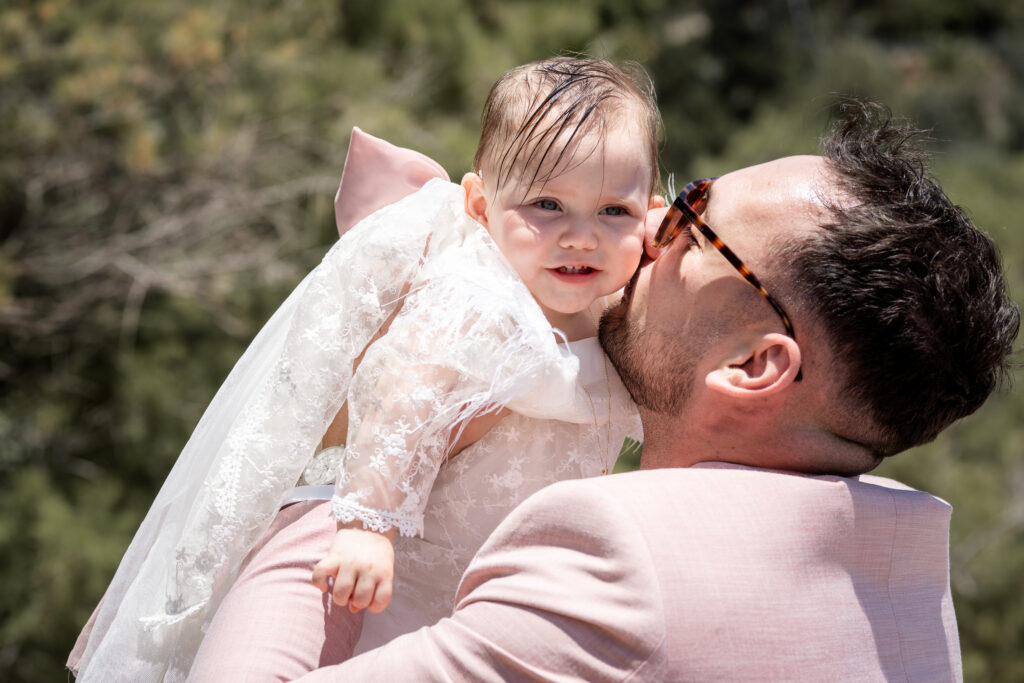
Tips for beautiful baptism photos
- Choose the time with the light in mind. A late-morning or late-afternoon christening usually gives softer light, especially in summer.
- Plan around your baby’s routine. A fed, rested baby means a calmer ceremony (and calmer parents).
- Ask the parish about photography. Each church has its own rules about flash and movement. I work discreetly, with natural light, respecting the sanctity of the space.
- Keep the font area clear. Ask guests not to crowd around the font, so the parents and godparent can see and be seen in the photos.
- Allow 15–20 minutes for family photos right after the service, while everyone is fresh and the baby is still in the white outfit.
- Consider a short session outdoors. The churchyard, an olive grove or a nearby beach make beautiful, relaxed portraits.
- Don’t forget the party. At the reception the family relaxes, and the candid moments there complete the story.
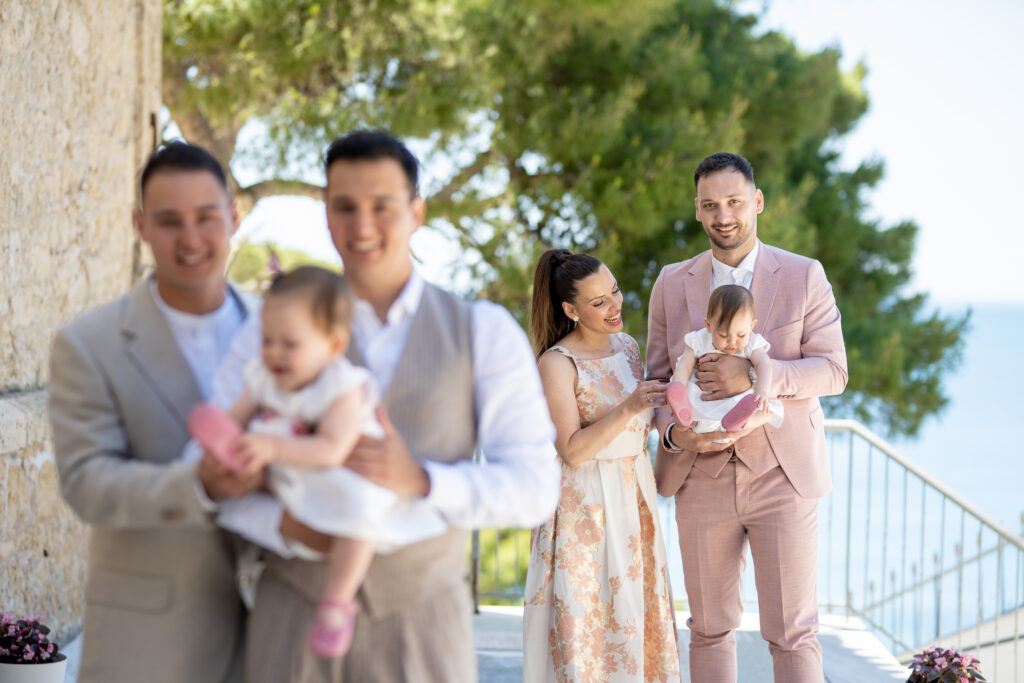
How to plan a baptism in Greece: timeline
Wondering what you need for a christening, and when? A simple timeline keeps everything from being left to the last minute:
- 4–6 months before (earlier for summer weekends): date, church, reception venue and baptism photographer.
- 2–3 months before: invitations, decoration, bomboniere and martyrika.
- 1 month before: gather the documents and confirm the time with the parish.
- 1 week before: send your photographer the schedule of the day and the list of family portraits you want.
- On the day: keep the candle, ladopana, outfit and martyrika together in one place, so they can be photographed before the service begins.
For a summer baptism in Messinia, consider an afternoon time: the heat is gentler for the baby and your guests, and the light is softer for photos.
Planning a baptism in Greece from abroad
Many families of the Greek diaspora choose to baptise their child in their home region: Messinia, Mani, Arcadia or Laconia. A few practical tips for a smooth day:
- Contact the parish months ahead and ask exactly which documents are needed, especially if the birth was registered outside Greece.
- Check with your Greek consulate whether any documents need translation or certification.
- If the godparent lives abroad, sort out their documents early too.
- Arrive a day or two before the baptism, so your baby can rest after the journey.
- Consider a photo session at the family home or in the village: these are the photos that move future generations the most.
How to choose a christening photographer in Greece
- Look at complete stories, not just highlights. A full baptism shows whether the photographer can “read” the sacrament from beginning to end. Take a look at my portfolio.
- Experience with the Orthodox service. Your photographer should know when the immersion is coming and where to stand without disturbing the priest.
- A style that feels like you. Natural light, candid moments, cinematic or more classic: choose what you will love looking at in 20 years.
- A clear package. Ask how many hours are covered, whether it includes the preparations and the reception, how many edited photos you receive, how soon, and whether there is an album. See my guide to baptism photographer cost in Greece for typical prices.
- Chemistry. They will be next to you on a very personal day, so a short call or meeting before you book makes a difference.
To get an idea of how photography pricing works, see also my guide on how much a wedding photographer costs in Kalamata.
Baptism photography in Messinia and the Peloponnese
If you are still looking for a church, see my guide to the most beautiful wedding and baptism churches in Messinia, from Kalamata to Mani, Pylos and Koroni. And for real stories: a twins’ baptism in Koroni, a cinematic baptism in Gialova, Stavrina’s fairytale baptism at Agia Sion, Kalamata and a wedding and baptism on the same day at Ypapanti, Kalamata.
If the christening will take place on the same day as your wedding, read my guide to a wedding and baptism on the same day in Greece.
FAQ: Greek Orthodox baptism and baptism photography
Who can be a godparent at a Greek Orthodox baptism?
A baptised adult Orthodox Christian who is not one of the child’s parents and, if married, is not married only in a civil ceremony. Confirm the exact requirements with your parish.
What documents do we need for a baptism in Greece?
The child’s birth certificate, both parents’ IDs, and the godparent’s documents showing they are Orthodox and their marital status. Your parish priest will give you the full list.
Can we baptise our child in Greece if we live abroad?
Yes, many families who live abroad baptise their children in Greece, often in their family’s home village. Contact the parish and your Greek consulate early to arrange the documents and any translations.
Can a wedding and a baptism take place on the same day?
Yes, a combined wedding and baptism is a very common choice in Greece. Arrange the order and timing of the ceremonies with the parish. See an example: a wedding and baptism on the same day at Ypapanti, Kalamata.
When should we book a baptism photographer?
As soon as you have a date and a church, especially for Saturdays and Sundays from spring to late summer, which fill up quickly.
Do you photograph baptisms outside Kalamata?
Yes. I photograph baptisms throughout Messinia, Arcadia, Laconia and Athens.
What should we ask before booking a baptism photographer?
How many hours are covered, whether it includes the preparations and the reception, how many edited photos you receive and how soon, and whether there is an album.
What is the best time of day for a summer baptism in Greece?
Usually the afternoon: the heat is gentler for the baby and the guests, and the light is softer for the photos.
Your baptism photographer in Greece
Your child’s christening happens only once. My job is to capture it as it really was: the emotion, the light, the people you love. See more stories in my portfolio, get in touch or book your date to check availability.